Stage 1
Learn soundness
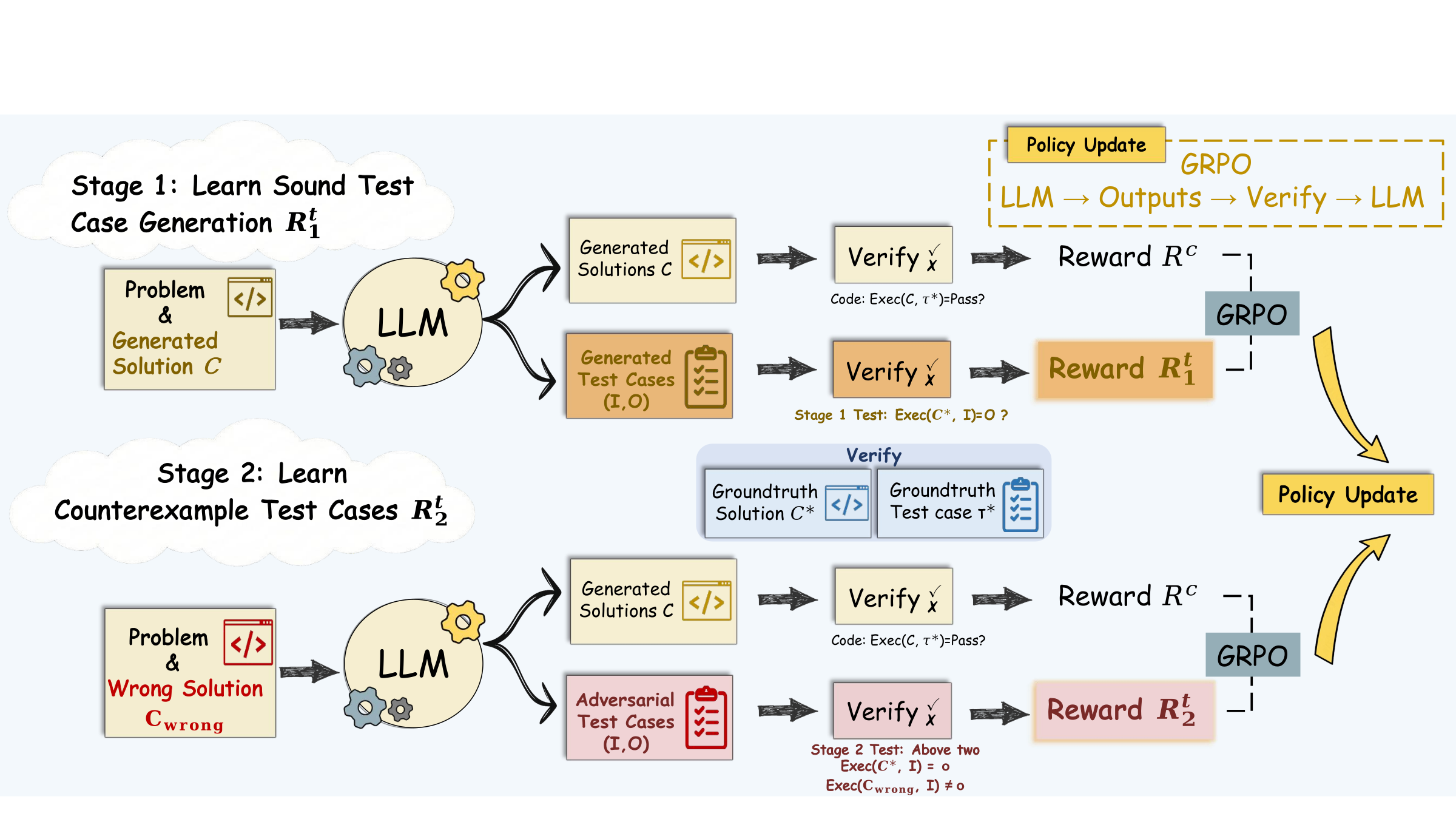
Reward novel generated tests whose outputs agree with the verified reference solution. This establishes a reliable test generator before adversarial optimization.
Two-Stage Reinforcement Learning for Sound and Adversarial Test Generation in Code LLMs
Nanyang Technological University · Skywork AI
Reinforcement learning (RL) has substantially advanced code generation with large language models (LLMs) through executable feedback. The feedback for coding problems mainly comes from specific test cases, where high-quality test cases are often scarce since they should be both sound and discriminative. We thus turn to study the auto-generation of test cases using the learned model.
We find this is naturally an adversarial RL problem: the model is expected to generate effective test cases as counterexamples, depending on the solver's current failure modes. We propose Test Cases Scaling (TCS), a two-stage RL framework for effective test generation. Both stages train a test generator from a rolling policy-aligned buffer: Stage 1 generates tests consistent with the reference solution, and Stage 2 restricts the buffer to current failure modes and learns counterexample tests.
Across TACO and LiveCodeBench, TCS improves both pass@1 and inference-time answer selection according to generated tests. We find the learned test generator also enables effective selection among other LLM outputs.
Keywords: Test Cases Scaling (TCS), code LLMs, reinforcement learning, test generation, executable verification, inference-time scaling, answer selection, TACO, and LiveCodeBench.
Generated tests are checked against a ground-truth solution to control false rejection.
Tests are rewarded for exposing plausible incorrect programs produced by the current solver.
The learned verifier improves inference-time selection for both TCS and external LLM outputs.
A staged verifier curriculum
Learning adversarial tests from scratch produces sparse and unstable rewards. TCS separates the objective into two stages while keeping training aligned with the evolving solver.
Reward novel generated tests whose outputs agree with the verified reference solution. This establishes a reliable test generator before adversarial optimization.
Condition on current incorrect programs and reward tests that pass the reference solution but fail the candidate, targeting the solver's changing error distribution.
Pool generated tests across sampled candidates, execute every candidate, and choose the program with the highest pass count.
TCS-7B · no public tests
Pass@1 measures a single generated solution. TCS selection samples multiple candidates and selects among them using self-generated tests.
pass@1 → selection with self-generated tests at N=32
pass@1 → selection with self-generated tests at N=16
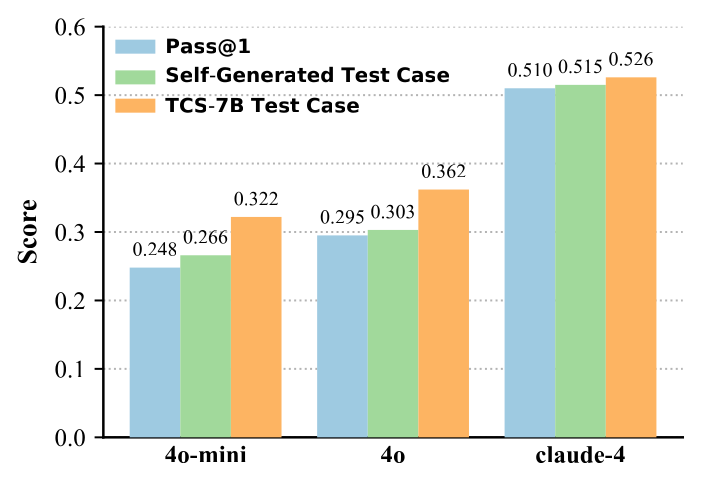
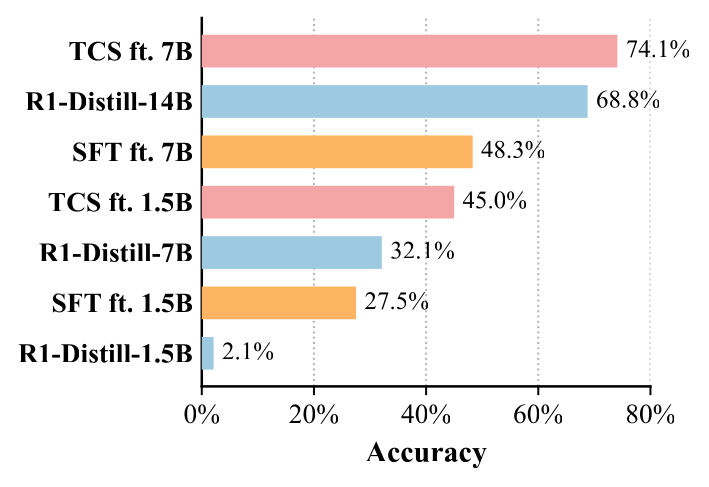
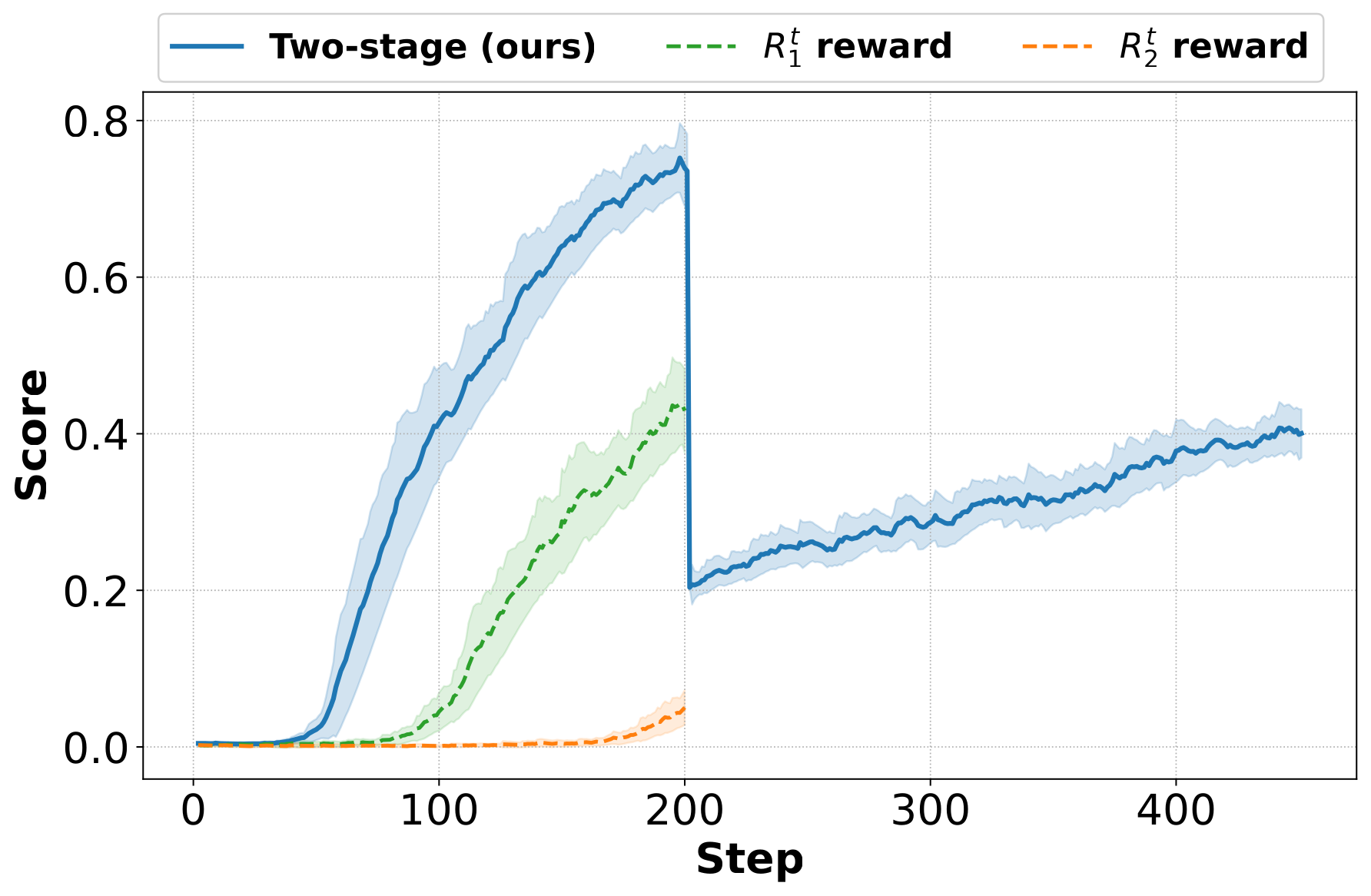
All values above are reproduced from the paper's main results. See the paper for complete baselines, public-test settings, model sizes, and evaluation details.
@inproceedings{xu2026tcs,
  title     = {Two-Stage Reinforcement Learning for Sound and
               Adversarial Test Generation in Code {LLM}s},
  author    = {Jiacheng Xu and Wentao Zhang and Zhiyi Lyu and
               Fuxiang Zhang and Chaojie Wang and Yang Liu and Bo An},
  booktitle = {Findings of the Association for Computational
               Linguistics: {EMNLP} 2026},
  year      = {2026}
}